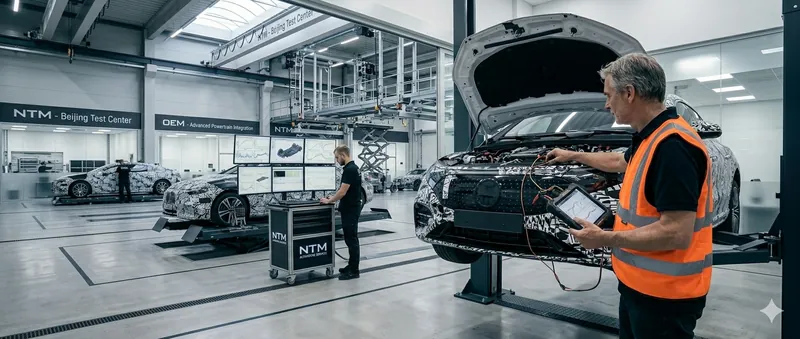
Own end-to-end vehicle testing for German OEM and Tier-1 programs in Beijing — from the first prototype loop to pre-SOP sign-off — with the autonomy to shape how testing is run.
About the Role
As Senior Automotive Test Engineer at NTM Engineering in Beijing, you are the technical lead on some of the most demanding vehicle testing programs in the Chinese automotive industry. You plan and drive complete testing campaigns for German OEM and Tier-1 clients — summer and winter trials, durability loops, road tests and benchmark drives — and you own the outcome end to end, from early prototype validation through to pre-SOP sign-off. This is not a narrow, single-task position: you carry the result, the schedule and the technical credibility of the program.
A typical week takes you across hardware, software and full-system levels. You define the test scope, supervise execution on the proving ground and on public roads, and dig into the hard faults that others escalate — the intermittent E/E issue, the durability finding that doesn't reproduce, the measurement that doesn't add up. You turn raw test data into clear, defensible decisions that OEM engineering teams in Beijing can act on immediately, and you document everything to OEM audit level.
Beyond the cars, you keep the engine of the operation running: you coordinate the test vehicle fleet and test-center operations, mentor junior automotive engineers, and act as the direct technical counterpart to our clients on-site. Because NTM works with short decision paths and direct founder access, the validation strategy you propose on Monday can be running on the fleet by the end of the week — without layers of bureaucracy slowing you down.
This role suits a senior engineer who has lived inside OEM or Tier-1 development, who is equally comfortable in the workshop and in a technical review, and who wants real ownership in one of the world's most dynamic automotive markets. In return you get demanding, hands-on engineering work, a trilingual international team, and a front-row seat to how vehicles are developed and validated in China.
Responsibilities
- Plan and execute vehicle testing campaigns (summer, winter, road tests)
- Hardware/software analysis and prototype validation
- Manage test vehicle fleet and test center operations
- Fault analysis, troubleshooting and test reporting
- Interface with OEM engineering teams on-site in Beijing
Your Profile
- 7+ years in automotive engineering, ideally at OEM or Tier-1
- Experience in vehicle testing, prototype management or E/E integration
- EFK / AuS qualification and/or 1000V certification a plus
- Fluent in German and/or English; Chinese a strong advantage
- Based in Beijing or willing to relocate
What We Offer
- Real OEM and Tier-1 projects — meaningful, hands-on work from day one, with no agency layers in between
- Short decision paths and a flat structure — you work directly with the founders, and your ideas reach the people who decide
- A close-knit, international team working in three languages (German, Chinese, English) in a truly intercultural environment
- A front-row seat in China's automotive industry — on-site in Beijing, Hefei and Shanghai
- Competitive compensation, relocation support and genuine room to grow
- A culture that listens: improvement ideas are discussed together as a team, not filed away
- Regular team events and a workplace where people genuinely look out for one another
- ISO 9001 environment, with an NDA signed from the very first conversation